The People Observing Illustration Pack: A Process-Driven Design Asset
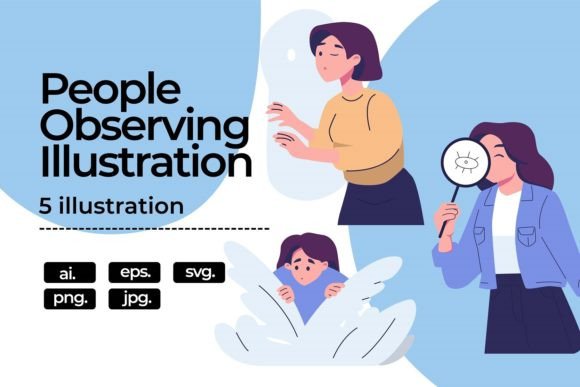
In the workflow of any visual communicator—from a designer building a website to a marketer crafting an infographic—there is a constant search for assets that do more than just fill space. They need to convey concepts, guide user attention, and enhance narrative without requiring exhaustive custom illustration work. This is where a focused resource like the People Observing Illustration Pack becomes a critical piece of the process. This pack provides five distinct, flat-style illustrations depicting people in acts of observation and subtle engagement, available in multiple vector and raster formats (EPS, AI, SVG, PNG, JPG). Its integration into a project isn't merely a decorative afterthought; it is a strategic step in the execution phase that supports clarity, user experience, and brand consistency.
Strategic Placement Within a Creative or Business Workflow
Understanding where this asset fits requires examining typical project phases. Initially, during the planning and wireframing stage for a website or application, placeholder imagery is used. However, using generic icons can mislead the client or team about the final tone. Having the actual illustrations from the People Observing Illustration Pack available early—even in their basic SVG form—allows planners to integrate the specific human-centric concept of "observation" directly into mockups. This ensures that the intended message of vigilance, research, evaluation, or discovery is baked into the layout from the outset, preventing a disruptive asset switch later.
Later, during the active design and development phase, the pack's versatility in format becomes a key efficiency driver. A designer working in Adobe Illustrator can manipulate the native AI or EPS files, perhaps changing the RGB color palette to match a brand scheme or altering a CMYK version for a print collateral offshoot of the project. Meanwhile, a web developer can directly use the optimized PNG or SVG files for implementation, ensuring crisp rendering on screen. This parallel usability eliminates the friction of format conversion, a common time-sink in collaborative workflows. The pack acts as a single source, distributed across different specialized tools used by different team members.
Interoperability with Other Tools and Methods
The value of an asset is often determined by how smoothly it interacts with the rest of your toolkit. The People Observing Illustration Pack is designed for this interoperability. Its flat, clean style ensures it complements, rather than clashes with, other design elements. Whether you are placing these illustrations alongside data visualization charts in an infographic, overlaid on photography in a blog header, or integrated into a UI dashboard alongside analytics widgets, the stylistic consistency is maintained. Furthermore, the editable color format means it can be adapted to exist seamlessly within established color systems used in project management software, brand style guides, or template libraries. It doesn’t demand that you alter your entire palette to accommodate it; you can adapt it to yours.
This adaptability extends to conceptual integration. For an educator creating online course materials, an illustration of a person observing a complex diagram can be used to visually cue the learner's own expected activity. For a small business owner building a service page, an image of someone discreetly evaluating a product (the "sneaking" concept) can subtly communicate the idea of detailed comparison before purchase. The pack provides the visual shorthand, which you then contextualize with your surrounding copy, data, and calls to action.
Practical Implementation and Workflow Examples
Consider a practical scenario: a freelance designer tasked with creating a website for a market research firm. The site needs to convey professionalism, analytical rigor, and human insight. The designer’s process might involve:
- Using the SVG versions of the observing figures in early client-presentation wireframes to establish the human-element theme.
- During full design, opening the AI file, changing the illustration colors to the client’s specific RGB blue spectrum, and extracting elements for use in the site's hero section.
- Providing the developer with a folder of PNGs for specific UI spots (like alongside "Our Methodology" text) and the SVG for a scalable interactive element.
- Later, when the client requests a one-page print summary, the designer quickly converts the same AI file to the required CMYK values and outputs a high-resolution JPG for the printer.
This entire chain utilizes one asset pack, avoiding multiple searches, purchases, or style mismatches. The workflow remains organized and consistent, a crucial factor for quality control and maintaining a cohesive brand voice across mediums.
Factors for Long-Term Usability and Organization
For the productivity-minded user, an asset's long-term value is paramount. The People Observing Illustration Pack addresses this through its foundational simplicity and editability. Unlike highly detailed photographic or 3D assets that may become stylistically dated, the flat illustration style has enduring applicability. Furthermore, because the colors are editable, the pack can be revisited and refreshed years later to match an updated brand identity without needing to redraw any core artwork.
Effective integration into your long-term system also depends on organization. A recommended practice is to store the master AI/EPS files in your central "Brand Assets/Vectors" folder, while placing the web-ready PNGs and SVGs in a project-specific "Web Assets" directory. This separation maintains the integrity of your editable master files while providing quick-access versions for different implementation environments. This organizational foresight, enabled by the pack's multi-format offering, turns a one-time download into a reusable resource that can expedite future projects where the theme of observation or evaluation is relevant.
Integrating the Pack into Your Routine
For professionals, creators, and entrepreneurs, the ultimate goal is seamless tool integration. Start by assessing your current project pipeline. Identify the common points where you need to visually represent concepts like scrutiny, learning, monitoring, or curiosity. The People Observing Illustration Pack fills that niche. Instead of treating it as an isolated graphic, consider it a process component.
Before a project begins, audit your existing asset libraries. Does your current collection have a gap for human figures in analytical contexts? Adding this pack proactively closes that gap. During project execution, make the conscious choice to use its vector formats for all major design work, preserving maximum flexibility. After a project is complete, archive the used files alongside the project documents, but keep the master pack in your active library, noted for its specific thematic strength. This cyclical view—from proactive gap analysis, to active flexible use, to reflective archiving—ensures the asset becomes a natural, almost instinctive part of your creative or business workflow, ready to serve not just one task, but many.
The practical outcome is not just a set of five illustrations on your drive. It is the elimination of a recurrent search task, the strengthening of project consistency, and the ability to communicate a nuanced human activity—observation—with clarity and speed. By focusing on its role within a process—from planning through execution to archiving—you transform a simple resource into a lever for greater efficiency and more effective communication.