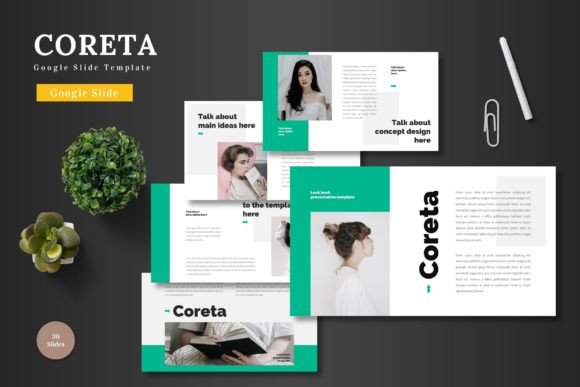
Coreta: The Multipurpose Google Slides Template for Modern Presentations
In the realm of digital communication, the presentation remains a cornerstone. Whether pitching to investors, educating a class, or promoting a new product, the ability to convey information clearly and compellingly is invaluable. This necessity has driven the evolution of presentation tools, with Google Slides emerging as a popular, accessible platform. However, the challenge often lies not in the tool itself, but in the time and skill required to design a professional, engaging slide deck from a blank canvas. This is where purpose-built templates like the Coreta Google Slide Template come into play, offering a structured, aesthetically refined foundation.
A Foundation of Design and Functionality
Coreta is described as a clean, scalable, colorful, and multipurpose template. These characteristics are not merely aesthetic claims; they form the operational backbone of the template. Clean design implies a focus on clarity and hierarchy, ensuring content is not overshadowed by unnecessary graphical elements. Scalability means the template's structure and components are adaptable to presentations of varying lengths and depths, from a quick ten-slide pitch to a detailed fifty-slide report. The colorful aspect, offered through five distinct premade color schemes, provides visual vitality while maintaining professional coherence. Multipurpose is arguably its most significant feature, indicating suitability for business, pitch decks, e-commerce showcases, product promotions, and beyond.
The Practical Workflow: Editing Entirely within Google Slides
A defining advantage of the Coreta template is its complete integration with the native environment. All elements are editable directly within Google Slides. This eliminates the common hurdle of requiring supplementary software like advanced graphic design programs. The workflow is straightforward: input your content into the provided text boxes, replace images by dragging and dropping into the dedicated picture placeholders, and adjust colors using the pre-defined palette options. This accessibility democratizes high-quality presentation design, making it available to users regardless of their expertise in external design tools.
The template includes practical slides for galleries and portfolios, which are particularly useful for visual industries. Furthermore, the inclusion of handcrafted infographics based on master slides ensures that data visualization is not only possible but also aesthetically consistent. Users can resize and edit these graphics without breaking their proportional integrity, thanks to pixel-perfect illustrations. This level of detail preserves quality while offering flexibility.
Analyzing the Core Components
To understand its utility, examining the included components is helpful. The offering comprises 150 total slides, distributed across five color variations, with 30 slides dedicated to each theme. This structure provides substantial volume without redundancy. Section break slides aid in organizing long presentations into logical chapters. The animated slide inclusion is a thoughtful addition, allowing for a moment of dynamic engagement during a presentation without requiring the user to learn complex animation tools.
Real-World Applications and User Scenarios
The broad suitability of Coreta means it serves a diverse audience. A startup founder can utilize its pitch deck-oriented slides to craft a narrative for potential investors, leveraging the clean layouts to highlight key metrics and vision. An e-commerce manager might employ the product promotion slides and gallery formats to showcase a new line of products in an internal meeting or a client-facing webinar. Educators and researchers can adapt the template for academic presentations, where clarity of information and visual support for complex concepts are paramount. Even hobbyists leading community workshops can benefit from a professional template to structure their content.
In each case, the user saves significant time on design fundamentals and can redirect their focus to curating and refining their message. This shift from design labor to content focus is a key practical benefit. The template acts as a collaborative framework, ensuring that even teams with varying design skills can produce slides that maintain a uniform, professional standard.
Considerations for Template Adoption
While templates like Coreta offer clear advantages, effective use requires some consideration. First, a template is a starting point, not a finished product. Its value is maximized when users invest time in tailoring it with their specific content, images, and data. The placeholder images are meant to be replaced; failing to do so can result in a generic feel. Second, while the color schemes are provided, users should choose one that aligns with their brand identity or the presentation's tone. Third, the abundance of slides (150 total) can be overwhelming. It is advisable to browse the master slides and sections first to plan which layouts are most relevant to the current project, rather than attempting to use every slide.
The promise of editing solely within Google Slides is a major convenience, but it also assumes a basic familiarity with the Google Slides interface. Users completely new to the platform may need to learn its core functions—such as how to edit text, replace images, and duplicate slides—before fully leveraging the template's editable features. The provided documentation, like the readme file and font/photo information, should be consulted first.
The Role of Templates in Modern Communication
Beyond the specifics of Coreta, this template exemplifies a larger trend in digital tools: the move towards streamlined, content-first creation. As software becomes more powerful, the complexity of its blank-slate environment can paradoxically hinder productivity. Pre-designed templates bridge this gap by offering expert-level design as a modifiable foundation. They establish visual rules—consistent fonts, spacing, color harmony—that users might not define themselves, thereby elevating the overall output.
For businesses and individuals operating in fast-paced environments, this efficiency is not a luxury but a necessity. The ability to quickly generate a professional presentation that maintains the quality of your brand or personal standard is a competitive advantage. It ensures that the medium of the slideshow does not detract from the substance of the message.
Final Observations on Utility and Reach
The Coreta Google Slide Template, with its emphasis on in-platform editing, extensive slide count, and multipurpose design, is a tool aimed at reducing friction in presentation creation. Its characteristics cater to a need for both speed and quality. The advantages are most tangible for users who regularly need to present information but lack dedicated design resources or time. By providing a robust starting structure, it allows the user's expertise—whether in business, education, or promotion—to take center stage, supported by a coherent visual framework.
In practice, adopting such a template changes the workflow from building the slides to filling them. This subtle shift can have a significant impact on the final product and the creator's experience. The template's inclusion of animated elements, infographics, and portfolio slides shows an understanding of contemporary presentation needs, where static text slides are often insufficient to capture attention and explain complex ideas.
Ultimately, the value of any template is measured by its ability to serve the user's content effectively. Coreta's design philosophy, built on clarity, adaptability, and integrated editing, positions it as a viable solution for a broad spectrum of presentation challenges, helping users communicate their ideas with confidence and visual polish.